
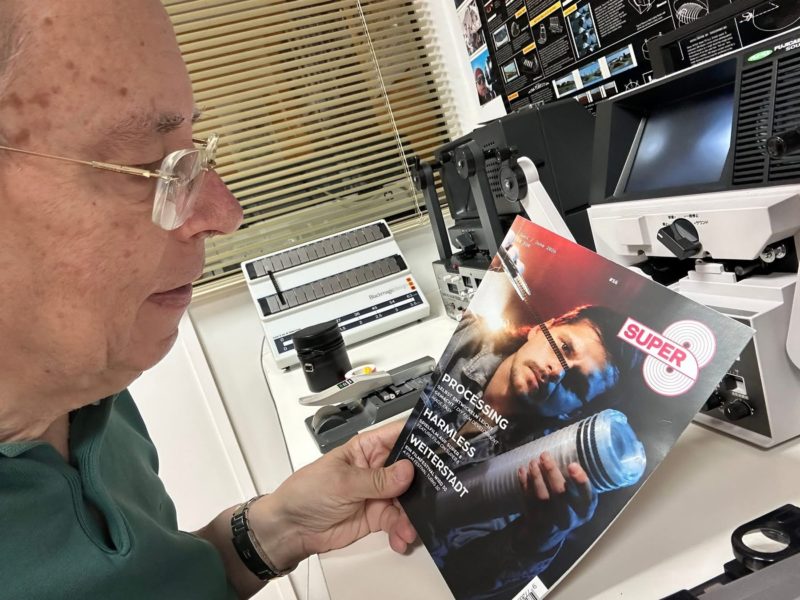
In today’s relentless digital world, where instant gratification has almost erased the pleasure of anticipation and nearly everything is consumed only to be forgotten a few moments later, a few precious reminders of better times still survive. One of them is undoubtedly SUPER8, the magazine that the indefatigable Jürgen Lossau continues to publish quarterly in both German and English.

Each issue is, in itself, a small celebration of photochemical filmmaking. Seventy-two beautifully printed full-colour pages, carefully bound in a format reminiscent of the classic Reader’s Digest, yet produced on paper of far superior quality. Even before opening it, the experience begins in a way that has become almost nostalgic today: the magazine arrives in an envelope bearing real postage stamps, a small detail that immediately transports us back to a time when receiving mail was an event in itself.

As always, the contents fully match the superb presentation. Every issue is a genuine feast for those of us who continue to enjoy shooting on film, both because of its outstanding graphic design and the consistently high technical standard of its articles.
This edition features an extensive interview with the renowned German technician Manfred Rehberger, whose decades of experience make his recommendations on the most reliable Super 8 cameras particularly valuable for today’s filmmakers and collectors alike.

Several pages are also devoted to the ambitious Super 8 feature film Harmless, a production with a budget of approximately 250,000 US dollars, proving once again that this small-gauge format remains perfectly capable of supporting major cinematic projects when backed by genuine artistic conviction.

Equally fascinating is the comprehensive article reviewing the various film processing machines available for advanced amateurs and small laboratories. Among the contributors is Frank Bruinsma, founder of Super 8 Reversal Lab, in Holland, one of the technicians whose opinions I hold in the highest regard. Among the processors evaluated is the magnificent JOBO CPP Classic, the very machine I use regularly in my own studio and one about which, after years of experience, I can only echo the excellent conclusions presented in the article.

As in every issue, there is also an overview of the major international Super 8 festivals, where it is always a pleasure to see the indefatigable Dagie Brundert, one of the most beloved and representative figures in the European Super 8 community.
In short, another outstanding issue of SUPER8, a magazine designed not to be read once and discarded, but to be treasured. A true collector’s publication, destined to earn a permanent place on the bookshelf and, over the years, to become an invaluable reference work for all of us who still believe that photochemical cinema has many stories left to tell.