
The Big Mac Is Coming: Polavision
Living Instant Pictures
There he stands, the man with 500 patents to his name, unveiling the secret. On April 26, 1977, before 4,000 shareholders in Needham, Massachusetts, Dr. Edwin Land announced the sensation: “It is not a TV, it is not a home movie theater, it is something brand new. We call it Polavision, living instant pictures.”
You make a movie—and 90 seconds later one can see the results in color and on chemical film. This invention, the company was firmly convinced, would cause a worldwide sensation eclipsing the 60 million Polaroid instant cameras sold thus far. Land, with personal assets then estimated at about two billion dollars, was chief executive officer and director of research of the U.S. enterprise. He presented the camera, the film and the projector for his revolutionary process himself. Lenny Lipton, a recognized authority on the subject, wrote in the American magazine “Super-8 Filmmaker” that Polavision was the “Big Mac” of the Super-8 system.

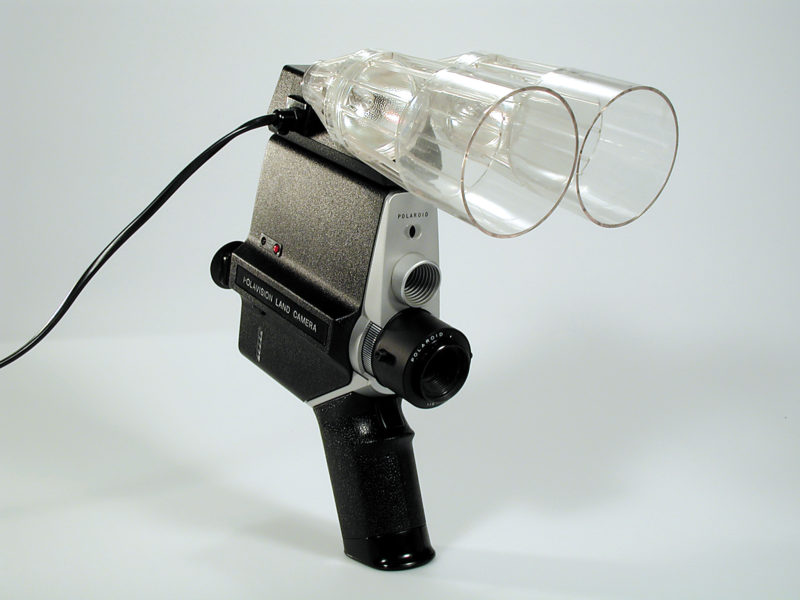
The simple movie camera with a 2x zoom and a maximum aperture of f/1.8 accepts an instant image cartridge. There are 3,000 individual frames on the Super-8 format film, which hums through the camera for at least two-and-one-half minutes at 18 frames per second. The lens offers only two pre-selectable distance ranges: 5 feet (1.5 meters) to 12.5 feet (3.8 meters) and infinity. Exposure is controlled electronically. An attachable bulb screwed into a socket comes on automatically as soon as the shutter is released.
The sensational thing is the 40-foot (12-meter)-long film that develops within its cartridge in 90 seconds. For this to occur, the cartridge is loaded into a player without any knobs or switches. During the 20-second rewind, 12 drops of developing agent are applied uniformly over the film. The tetramethyl acid dries almost instantly so the individual layers of material do not stick together. After another 70 seconds, those freshly shot images flicker across the 12-inch (30cm) projector screen. How is that possible?
The extremely thin tungsten emulsion made of polyester is in fact black-and-white film. The developed film consists of both a negative, which remains almost invisible in the film layer, and a positive, with a high degree of registration. While the film is being run through the player, the light from the projection bulb penetrates the image layers. In addition, each millimeter of film material contains 177 very thin stripes in the primary colors red, green and blue. This linear pattern acts as a color filter for the negative-positive black-and-white material. Experts call this additive color film.

The stripes cannot be separated from the small 5.2×2.8×0.5 in. (133x70x13mm) cartridge. Therefore the film can neither be edited nor receive a soundtrack. The cassette can be inserted into the player over and over again to be presented immediately. Edwin Land was optimistic about also being able to build a sound version of the Polavision system in 1978. Yet the camera and player combinations sat stoically on the shelves. After six months, in early 1979, only 1,000 units had been sold in Germany. Video was on its way. This expensive DM 1,200 Polavision system could not reach the intended audience—family home moviemakers. Also, the Super-8 market had crashed.
Thus Polavision disappeared from view and turned into a disaster for the company that was fabricating the devices for Polaroid: Eumig in Austria. Eumig had counted on manufacturing at least 150,000 sets annually, and now they had a problem. Bell & Howell, the company that had initially negotiated with Polaroid to make the devices, was relieved that nothing had come of the deal. It has never been revealed under what conditions Eumig fabricated the cameras and players for Polaroid. A previously prepared contract with Bell & Howell allegedly said: $220 for the initial 45,000 units, $169 for the next 150,000 and $162 for an additional 250,000. But those figures are now inconsequential.

All in all, Polavision was nothing more than a party game. Friends and relatives are happy when, having just been filmed, they see themselves flashing and flickering across the tiny screen. The coarse-grained film takes the audience back to the days when color film was first invented—that’s how it must have been then, one thinks subconsciously. As a party gimmick I still use old Polavision cartridges that in fact were supposed to have been processed before 1979, and the coarse-grained images still develop before the audience’s eyes and hop across the screen. It must be granted to Mr. Land: his developer chemistry is long-lived.
For a collector, the other Polavision camera of which some 100 units were fabricated is of much greater interest. It is the “Mekel 300,” a specialized device used for workflow analysis. Up to 300 frames per second can be exposed with this high-speed recording system. Its companion Polavision player then presents flicker-free slow-motion footage at 2, 4, 6 or 9 frames per second. Still image, single-frame operation and instant replay for sports, medical or scientific purposes are also possible with this projector.