
An unconventional family
Canon’s 16mm Scoopic models
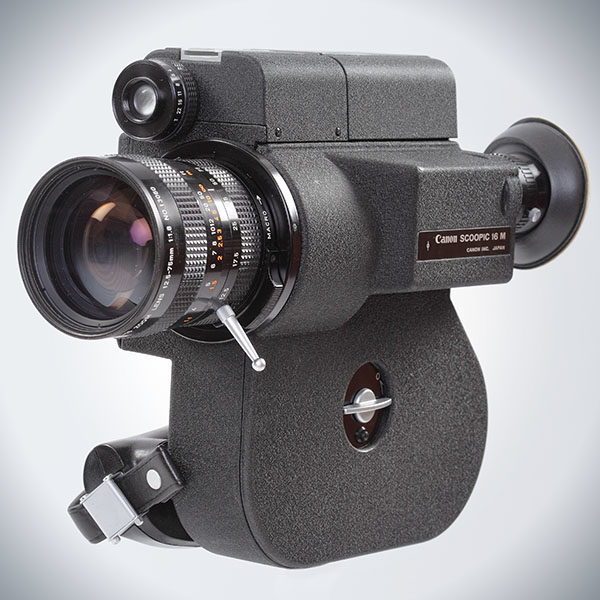
Canon, today a market leader in digital photography, was once known as a manufacturer of small-gauge movie cameras. Their Super 8 models are still respected for their robustness and good lenses, however Canon also made a rather late entrance into the larger format niche market. For the production of news footage, Canon responded by building a simple 16 mm camera: the Scoopic 16.
One finds spade and spoon under the dictionary entry for “scoop,” among other things. However, Canon chose the name to connote “exclusive news or media coverage,” since it was designed for what we now refer to as ENG (Electronic News Gathering), as the first 16mm camera with attached zoom lens, built-in exposure meter with automatic aperture control and semiautomatic film loading. At that time the standard was not Betacam, but 16 mm film. The first Scoopic 16 hit the market in 1965, followed by seven additional models, including the Sound Scoopic with magnetic soundtrack recording in 1970 and the 16M with magazine shaft in 1977. Today it is seen as a 16mm device with a Super 8 heart, because of the simple operation that distinguishes this machine.
The lens
The Scoopic 16M and MS models have a built-in 6-times zoom lens which consists of 16 elements. In return for the high investment, one receives sharp images with highly faithful colors. The actual speed of the lens is reduced from f/1.8 to a usable f/2.5 by the viewfinder prism. The focal length ranges from 12.5 to 75 mm. Although many filmmakers firmly declare the built-in lens to be the great disadvantage of the 16M, it is very flexible with built-in two macro modes. Scenes can be filmed in the normal mode as close as 80 mm in front of the lens – convenient for titles, postcards or insects. One can pull focus directly from the macro mode in the normal focal length range. The second macro mode is for use with an ancillary lens like the Schneider UWL4 or macro attachments specifically available for the Scoopic. See the “Tele and wide-angle use” section for more on this topic. The Scoopics do not feature a motorized zoom – one searches in vain for this seesaw feature.
The camera body
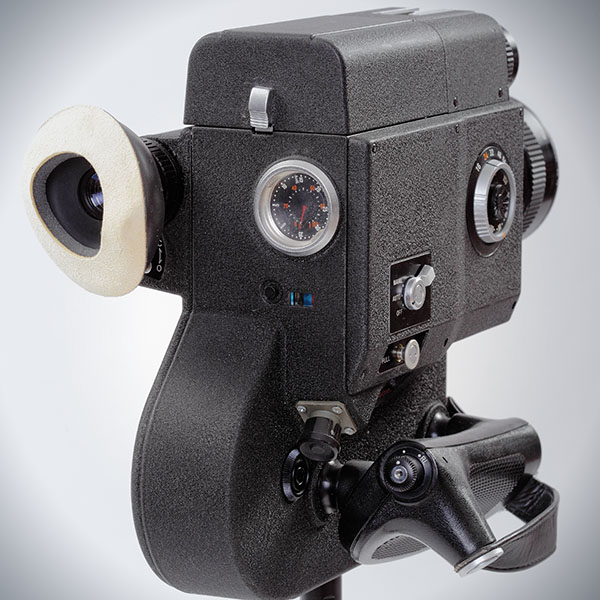
The reflex viewfinder is a prism type similar to the Bolex H-16 with eyepiece on the left, which is why the tube and eyepiece are accommodated in the door. Metering information and an over/under exposure warning lamp are also superimposed below the finder image. In comparison to other 16mm cameras, the finder image is pleasantly large. Diopter adjustment and an ocular lock exist, of course. After opening the door, one sees the little ground-glass plate that is turned at a right angle on the left of the spools. Care is required here not to cause damage to the small protective pane while loading and unloading the daylight reels. A semi-automatic feed leads the film masterfully up to take-up reel, where it must be attached by hand.
One adjusts the film sensitivity and shooting speed on the right side using a setting wheel – the middle rosette knob adjusts the ASA number, the outer ring adjusts shooting speed to 16, 24, 32, 48 or 64 fps. The control works with a 170 degree rotating shutter – the following exposure times are possible at 16 fps: 1/34, at 24 fps: 1/51, at 32 fps: 1/68, at 48 fps: 1/102 and at 64 fps: 1/136.
A simple selector switch allows manual or automatic operation. Pulling the knob out lets the camera operate in single frame mode. In the handle behind the trigger is a thread for the wire remote release. Rotating the release knob selects Run Lock mode. On top: a respectable equipment shoe. On the backside with the eyepiece is a button to check battery level and a frame counter similar to a clock. A socket for external electrical supply is found beside the trigger. This 4-pole plug is so exotic that even after years of more or less intense searching, no matching plug can be found. The battery packs for the Scoopic S do not fit the M/MS. This brings us firmly to the next topic:
Cell replacement and a new battery charger
Even if the old batteries still function, exchanging them for new NiMH cells can multiply their capacity. The battery case can be easily opened with two screws and the AA Type rechargeables with soldertails can be replaced with new NiMH cells. Chargers for the new batteries are available from specialized electronics suppliers, because the original battery charger is suitable only for NiCd packs. The M and MS require the S-12 Type battery housings. The round Scoopic S battery is incompatible with the later angular models, because it does not fit in the battery receptacle.
Exposure meter and film sensitivity
The 16 M/MS has an automatic aperture control driven via a photoelectric cell under a light diffuser on the camera (thus not TTL). One also finds this type of EE (Electric Eye) on many Canon Super 8 cameras. Therefore, when using filters one must pay attention to exposure correction. The exposure meter in the 16M will only read correctly if the same light conditions prevail at the camera and in the scene. To examine the value, one can aim the camera against the shooting direction in the scene and measure the value there. In each case, one should compare the results from the camera’s built-in meter against an external exposure meter before shooting a significant quantity of film.
Tele and wide-angle us
The macro capability allows every ancillary lens with a 72mm thread diameter to be used. Designs that are convex or concave on the objective side must be exactly stopped with the macro feature. For example, the Schneider UWL 4 wide-angle converters and also the Macro Wide Angle 9mm ancillary lens from Canon that was produced specifically for the Scoopic M series. The lenses should be absolutely clean, because the macro makes every scratch and every dust particle on the converter visible. Objective-side planar ancillary lenses do not exhibit this problem, because they are used without macro settings and are – with or without vignetting according to the original focal length – “fully zoomable.” One can find versions on the Semi-professional video market. Many new HDV cameras have a 72mm filter thread – like the Scoopic 16 M – and also accept a wide-angle converter or tele-converter. However, these are usually massive glass blocks and need, perhaps, a lens support. Test to see if one is required before purchasing!
Frame timer
The Scoopic M/MS offers a mechanical single frame mode. As in the case of Bolex and Beaulieu, the NCS Timeflow (http://www.intervalometers.com/timeflow/tivscoopic.stm) can be used as a frame timer with a servo-driven mechanical advance. In the ideal case, one uses a setting of 16 fps (at 1/34). Long exposures are not possible with the Scoopic.
Secondhand models
The classic Scoopic has a dark grey case, a silver plate on the front and a grey handle – the aluminum case is coated completely with black shrink lacquer on all other models. The scarce sound models are rarely offered for sale, on account of massive wear or the absence of suitable film stock. The popular M and MS models fetch prices of about 1000 euros in good condition. The purchase should include at least one battery pack that can be re-celled with new NiMH cells. Accessories such as a wide-angle converter or tele-converters can be complemented, perhaps, with new products from the video or photo world. These products should be tested with the Scoopic before making larger purchases.
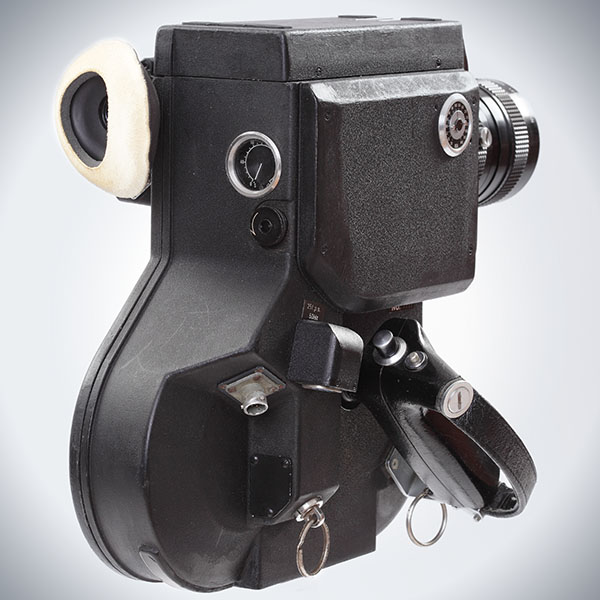
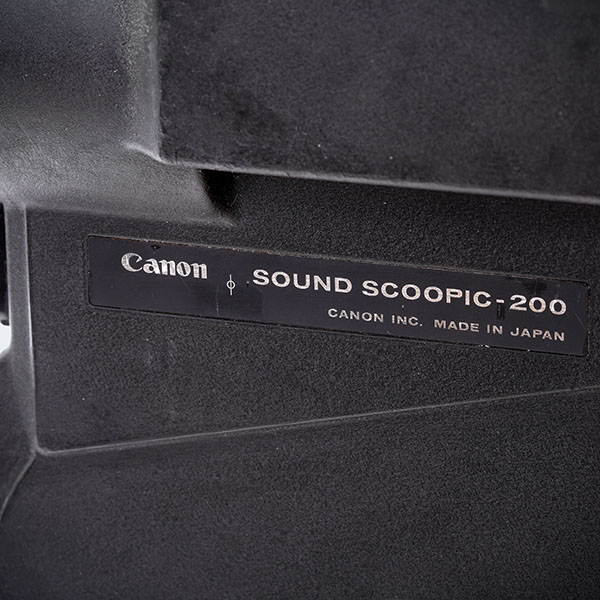
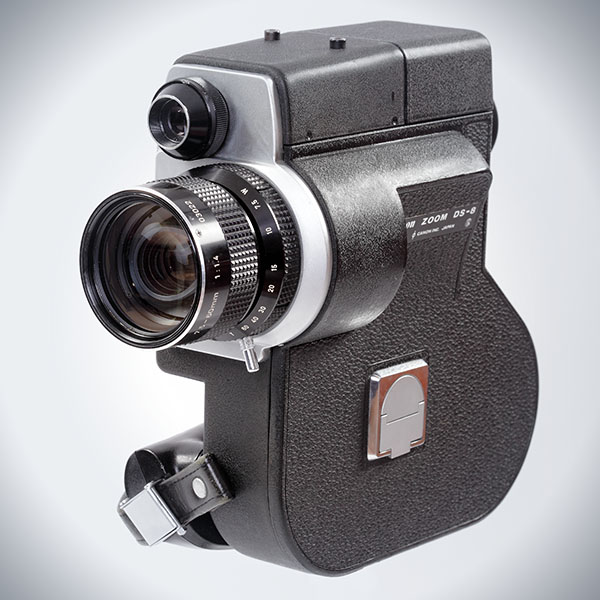
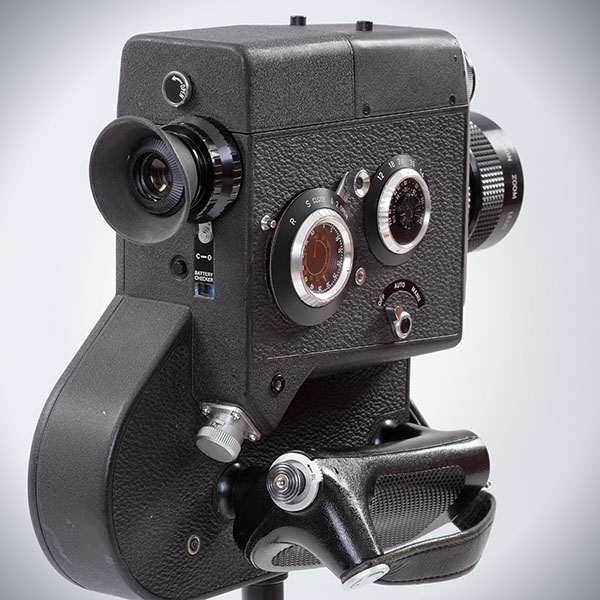
Overview of all Scoopic models
All models feature the described automatic aperture with EE (Electric Eye) exposure meter above the objective. Individual types can be distinguished as follows:
Scoopic 16, 1965, according to Canon this was the first 16mm camera with built-in zoom lens, 13 to 76 mm focal length(f/1.6). 30 m daylight reel, shooting speeds: 16, 24, 32, 48 fps, 135 degree shutter
Scoopic DS-8, 1970, Double Super 8 Model in 16mm housing, 7.5 to 60 mm (f/1.4) zoom lens from the Canon Auto Zoom 814, shooting speeds: Single frame, 12, 18, 24, 36, 54 fps, 0-165 degree variable shutter, e.g., For shooting headlights on full beam and fade-outs
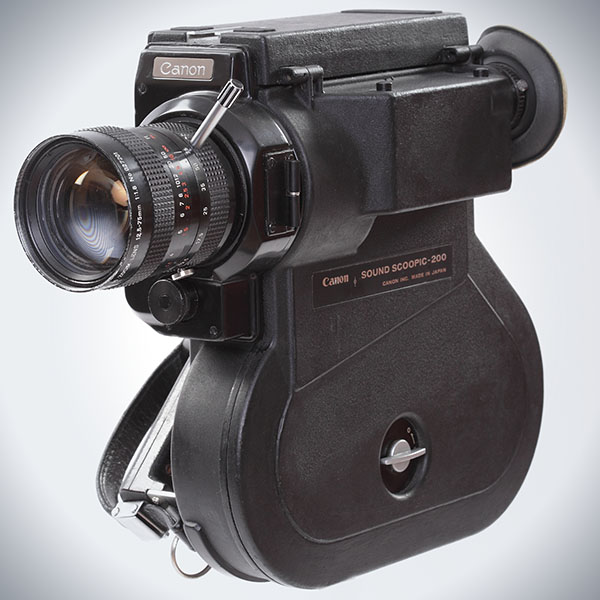
Sound Scoopic 100, 1970, 30 m daylight reel, magnetic soundtrack circuitry with 28 frame distance between sound recording and film gate, frequency response: 150 to 8,000 hertz, shooting speed: only 24 fps, 135 degree shutter
Sound Scoopic 200, 1970, 60 m daylight reel, like the Model 100, but with 200 foot load capacity
Sound Scoopic 200 S and SE, 1972, new faster zoom lens (f/1.8), 60 m daylight reel, magnet sound recording, frequency response: 200 to 8,000 hertz, shooting speed: only 24 fps, 170 degree shutter, SE features special TV frame lines on the ground glass
Sound Scoopic 200 S 10, 1972, 60 m daylight reel, similar to the 200 S, however with removable optics and a 12 to 120 mm zoom lens
Scoopic 16 M, 1973, 30 m daylight reel, new 12.5 to 75 mm (f/1.8) Vario objective, “M” stands for “macro,” shooting speeds: single frame, 16, 24, 32, 48 and 64 fps, 170 degree shutter
Scoopic 16 MN, 1974, like the 16M only without single frame operation, with internal filter slot on the right side
Scoopic 16MS, 1977, like the16M, but with internal filter slot on the right side and a new magazine shaft on top for Mitchell Type 16 or Cinema Products CP16R magazines with 122 m loads.