
All you Need is 8mm
The Beatles and Their Amateur Movies
Photos: ACW
They are legends. And before the first professional films featuring the Beatles appeared in 1964, the Fab Four who wrote the history of pop music had already filmed themselves on 8mm. Whether they still found the time to film during the fame, wealth and stress that overcame them in the following years is unknown. But in 1963, the Beatles already felt like part of the small gauge film scene.
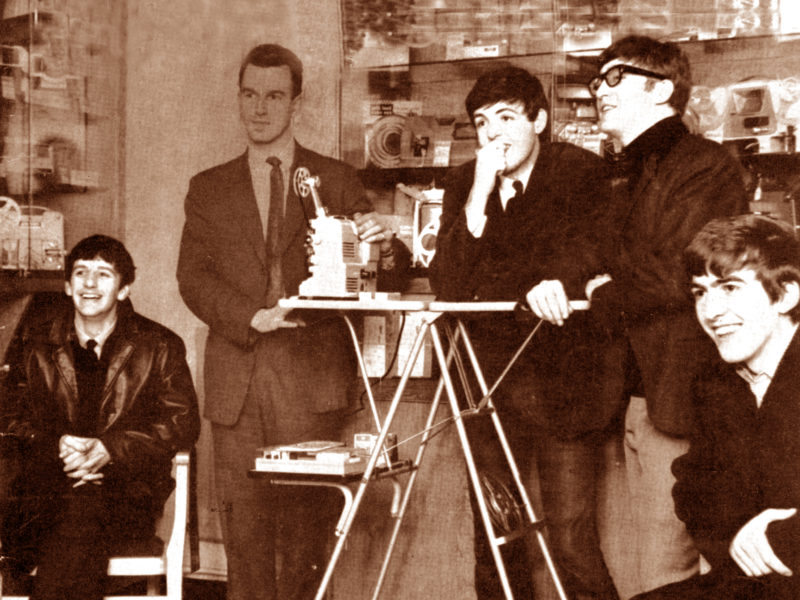
Here they stand; the Beatles. They are having a look at their first colour 8mm film at a London photo shop, more precisely the West End branch of Westminster Photographic Ltd. Ringo Starr, the amateur cameraman, is on the left beside Paul McCartney, John Lennon, George Harrison and the shop assistant from the photo store. Photographer Dezo Hoffman shot the ensemble early in 1964.

However, Ringo – with his Elmo Pocketauto 8mm camera – was not the only one shooting. Paul McCartney also had a small format cine camera: the Canon 8EEE. The shopkeeper at the Westminster photo store was quick to broadcast the skill of the amateur filmmakers, “These boys are great cine enthusiasts. And Paul McCartney has certainly got the know-how of cine with his Canon 8EEE. The results are surprisingly good,” said shop manager M. Mackay. Presumably, he had seen the 8mm footage the Beatles shot in Liverpool on March 25, 1963.
Paul McCartney gave an interview to the Westcliff Cine and 35mm club at the end of 1963. In it, he revealed to chairperson John Kennedy Melling that the popularity of the Beatles brought both advantages and disadvantages in terms of private filming. Though they could now afford the newest and most expensive small format film equipment, they were unable to film anywhere undisturbed. A little sphere of privacy lingered only in theater dressing rooms, hotel rooms or during stays in the country. And then they would shoot. Paul quickly describes the most thrilling shot: He filmed newspaper photographers fighting over them in their dressing room – a case of man biting dog!

The Westcliff Club enjoyed involvement with public figures. One of their patrons asked Alfred Hitchcock for a message for the Westcliff film show. Hitch sent back a 400 ft reel of 16mm sound film produced especially for the club. English magazine Amateur Cine World (ACW) reported at the time that this film “Will make other clubs green with envy.” The Beatles had also heard of this film and wanted a chance to see it. Although they were 8mm filmmakers up to that point, they planned to buy themselves 16mm sound projectors in 1964. They wanted to be able to watch the television spots that they had made for broadcast on the show ‘Juke Box Jury.’
However, the Westcliff Members were already somewhat critical of the Beatles. The storylines in the Beatles film are “rather slim,’ they believed, although they immediately stressed that this was due to forced circumstances. The publicity officer for the Westcliff Club also found conciliatory words to conclude the conversation with the Beatles, “I am convinced,” he said, “that if the Beatles were in a profession that demanded less of their time, they would apply themselves to their hobby with the same powers of concentration which they devote to their stage craft, and become a credit to the celluloid world of the amateur.”

The whereabouts of the private footage filmed by Ringo and Paul remains unknown. Exclusive never-before-seen footage of the Beatles was released in 2007 under the DVD title “The Beatles – A Film By Mal Evans.” The material was filmed by the Fab Four’s former roadie Mal Evans and has been hidden for decades. The clips include secret concert footage as well as revealing private conversations and personal exchanges within the band. The historic footage includes live concert performances, the Fab Four chatting as they travel down the Thames on a boat and the band riding down London’s Park Lane in a car with their friends and rivals The Beach Boys.
Other recently uncovered footage includes Rolling Stones legend Charlie Watts discussing the cult of celebrity, years before such a phenomenon was ever recognized, and live recordings of Jimi Hendrix playing in front of the Beatles. MBop has released the material and has made some reformatted and restored clips available for download at MBopMegastore.com.
Evans was shot dead in 1976. His widow Lily discovered the 8mm cine footage in their attic before selling it at Christie’s auction house. However, most buyers of the DVD on Amazon.com have left disappointed comments about the quality of the film.